
Translate AI Potential into Enterprise Value
The rise of Generative AI has captured global attention. But while consumer tools have taken off rapidly, the real opportunity for businesses lies in applying AI within the enterprise. When applied with intent, Enterprise AI can streamline workflows, improve productivity, and augment decision-making across the value chain.
The future of enterprise automation will be defined by autonomous, governed, and collaborative AI agents integrated into your workforce. This new era of Enterprise AI requires the same disciplined approach as any other transformative technology initiative, balancing People, Process and Technology. The principles remain consistent – define clear objectives, align with your business process, and ensure the right governance.
What makes Enterprise AI different is its ability to go beyond incremental efficiency gains, and act as a true operational partner, enhancing existing workflows and creating entirely new opportunities for value creation.
What Is Enterprise AI?
To understand Enterprise AI, let’s start by explaining how it is different to Consumer AI. Consumer AI refers to AI technologies designed for everyday personal use, often embedded within apps, devices or digital services. These tools are built for accessibility and convenience, helping individuals with tasks like answering questions, generating content, making recommendations or automating simple routines. Examples include AI chatbots, personal assistants like Siri or Alexa, generative AI apps for writing or art, and recommendation engines on platforms like Netflix.
Enterprise AI on the other hand, focuses on integrating AI into complex business processes, operations and governed workflows at scale. Whilst it will include many of the elements of consumer AI (chatbots, GenAI, recommendations), it takes this a step further by allowing interaction with organisational systems, processes and teams, to support or automate tasks, improve decisions, and drive productivity. Unlike consumer AI, enterprise-grade solutions must be:
- Scalable across departments and use cases
- Secure and compliant with industry standards
- Integrated into existing data, workflow and application ecosystems
- Explainable to ensure transparency around the decisions made by AI
- Built from modular components that can be orchestrated across processes
- Multimodal, handling structured and unstructured data
- Low-code / No-code configurable, accessible to both technical and business users
Why Enterprise AI Is Becoming Essential
Several forces are driving the need for enterprise-level AI:
- Data Proliferation: Businesses are overwhelmed by structured and unstructured data. A study by Forrester states that on average, 68% of enterprise data goes unused for analytics.
- Pressure to Automate: Enterprises are under pressure to do more with less. AI can take over repetitive, manual work.
- Speed of Decision-Making: Whilst traditional BI tools are fundamental requirements for showing KPIs and analysis, they are typically not fast enough to act. AI integrated into company systems enables real-time responses.
- Tool Maturity: Advances in cloud, APIs, and foundation models make it feasible to deploy AI more broadly.
- Ecosystem Integration: AI platforms now connect seamlessly with CRM, ERP, and messaging tools, making enterprise-wide automation possible.
Winning organisations will be those that embed AI into everyday workflows and decisions, turning potential into performance.
Where Do You Start? The AI Maturity Framework
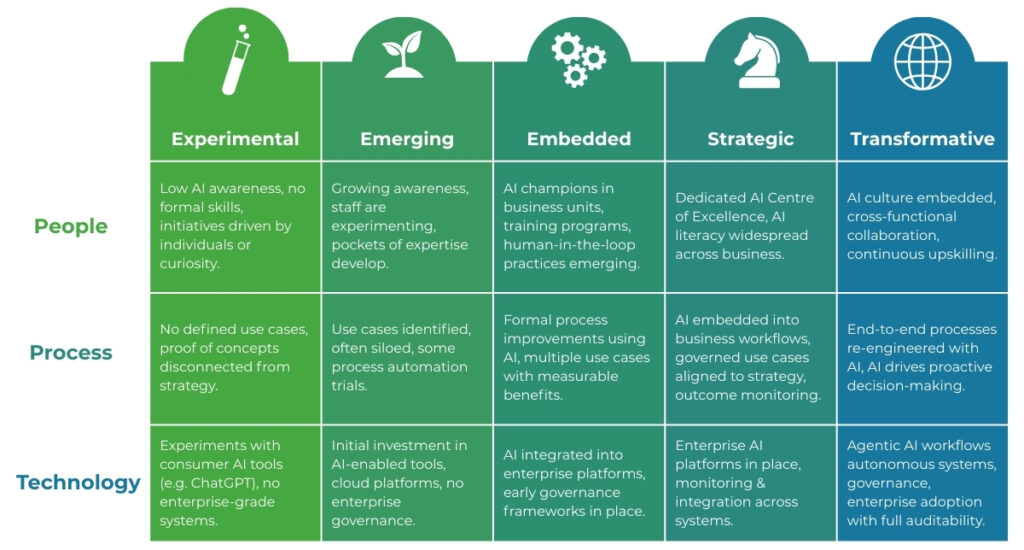
For many organisations, the most difficult part is knowing where to begin. Everyone recognises the potential of AI, but few have a clear picture of their current readiness. That’s where an AI Maturity Framework comes in. Much like data maturity models, the AI maturity framework provides a way to:
- Measure where you are today across People, Process and Technology
- Define where you want to be in 12–24 months
- Analyse the gap to determine the skills, processes, and tools needed to get there – this is your AI Strategy. Consider elements such as:
- What business problems are we solving with AI?
- How will we scale pilots into operational capability?
- What frameworks will govern ethical use?
- Who owns AI enablement and delivery?
- How will we manage and monitor agent behaviour over time?
At its simplest, the AI Maturity framework moves organisations through five stages:
- Experimental – AI used informally, often via consumer tools.
- Emerging – First departmental use cases, usually siloed.
- Embedded – AI woven into workflows with measurable benefits.
- Strategic – AI aligned to business strategy, governed and scaled.
- Transformative – Enterprise-wide adoption, with AI agents driving proactive decisions and innovation.
People, Process, and Technology in Practice
- People: Empower employees to use, trust, and co-create with AI. Build multidisciplinary teams across IT, Ops, and Business. Train users not just on tools, but on responsible use and interpretation (AI literacy).
- Process: AI must map to existing workflows and decision points. Embedding AI in an invoice approval process or supply chain monitoring flow creates real value, whereas disconnected pilots rarely scale.
- Technology: Choose platforms that are flexible, secure and are easy to integrate. Prioritise agent orchestration, explainability, and governance capabilities. Ensure compatibility with your existing cloud, data, and application architecture.
Pick value-adding use cases
A successful AI initiative is not about picking the right model but rather about solving the right problem. To identify and prioritise your AI initiatives within your AI strategy, consider the following questions:
- Use Case Identification: What decision or process can AI augment?
- Data Readiness: Do we have the right data? Is it clean and accessible?
- Workflow Fit: Where does the AI integrate into business operations?
- Human Oversight: What are the guardrails? Who remains in control?
Common use cases include:
- Automating reporting and commentary
- Summarising and classifying documents
- Matching CVs to job specifications
- Enhancing service desk operations
- Extracting insights from unstructured text
- Generating first drafts of communications, policies, or reports
- Generating quotes and contracts
- Enriching CRM records with contextual summaries
Modern AI platforms allow these use cases to be built using modular agents that can be configured and orchestrated with minimal coding, enabling rapid time-to-value.
From Hype to Habit
Every organisation is somewhere on the AI maturity curve, and regardless of where your organisation is, your first step is to understand the gap between where you are and where you want to go, and build a plan grounded in people, process and technology to close the gap. Like the implementation of any enterprise-wide platform, it requires leadership, structure and purpose to embed AI into the fabric of your business. Enterprise AI isn’t about chasing hype – it’s about turning AI into a habit – a structured capability that scales, governs itself, and creates tangible operational value across the business.
By Upuli de Abrew, Co-Founder and Director at Insight Consulting