
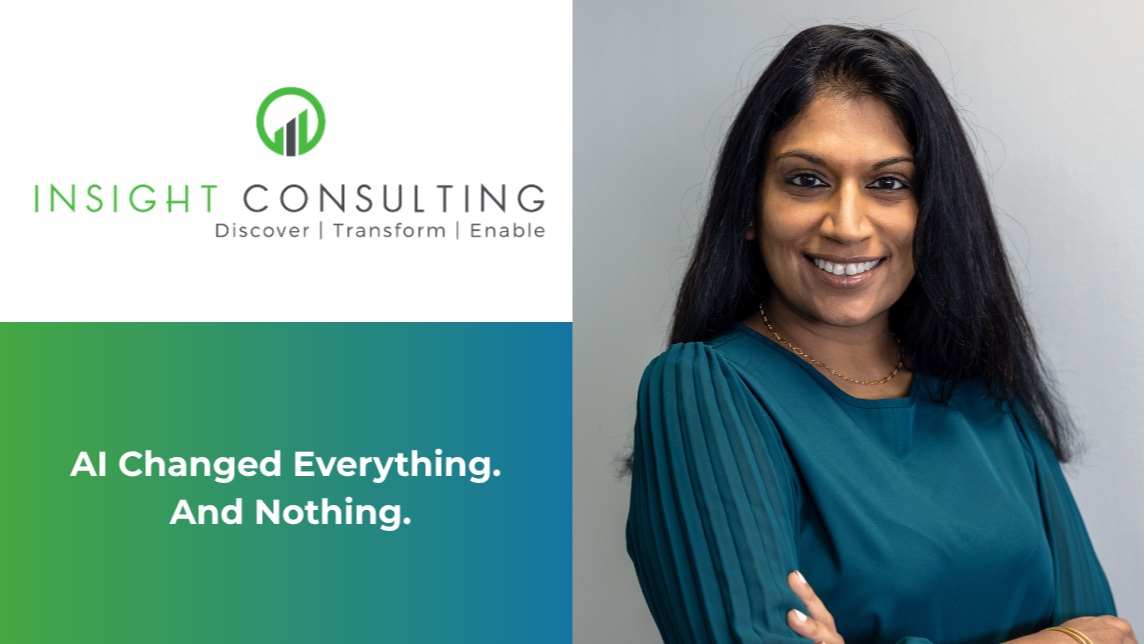
By Upuli de Abrew, Co-Founder of Insight Consulting.
In April 2026, the South African government withdrew its first National AI Policy. The reason wasn’t political or ideological – it was that someone had used a generative AI tool to help draft the document, and nobody had checked the citations. Some of the 67 references either didn’t exist, or pointed to articles never published in the journals they were attributed to.
The editors of three respected journals individually confirmed that papers credited to their publications had simply never been written. CNBC Africa
The document had cleared cabinet, been gazetted and released for public comment. That was when journalists started checking the footnotes and found the hallucinated citations.
I’ve been working in data and analytics for 25 years. When I read the Minister’s withdrawal statement, I didn’t actually feel surprise – I felt a strange kind of déjà vu.
This isn’t really a story about AI. For me, it’s a story about something I’ve watched play out for over two decades: the gap between having information and having knowledge, between producing an output and trusting it and, between using a tool and doing the work well.
We’ve been here before
Every generation of technology produces its own version of this story. The printing press produced pamphlets full of confidently presented nonsense. The spreadsheet produced “the number” that nobody could trace back to a source. The data warehouse produced single sources of truth that contradicted each other across departments. Each new tool collapsed the cost of producing output, but each new tool revealed – slowly, expensively, sometimes embarrassingly – that the cost of trusting the output had not collapsed at all.
Long before generative AI, I sat in rooms where executives presented numbers from dashboards nobody had verified. I worked with companies whose “single source of truth” produced three different answers depending on which department you asked. I watched BI projects falter not because the technology was wrong, but because nobody had asked whether the underlying data could be trusted, whether the question being answered was the right one, or whether anyone in the business actually knew how to read what they were looking at.
The pattern hasn’t changed – confident-looking output, missing verification layer, a chain of people each assuming someone earlier in the process had done the checking. The policy story is just a very public version of something that’s happening inside organisations more often than we think.
What’s different now is the speed, and the polish. Practitioners have been saying for a while that AI doesn’t fix bad data, it amplifies it. That’s true, but I’d go a step further and say that AI disguises bad data. A messy spreadsheet used to produce an obviously messy chart. The same spreadsheet, run through the right prompt, now produces a confident, well-written paragraph that sounds like it knows what it’s talking about. The mess is still there, but it looks more authoritative. The discipline of asking “where did this come from, and do I trust it?” has never been more valuable, and its never been easier to skip.
The work underneath the tools
That pattern is the reason Insight exists, and it’s a large part of why we’ve grown for nearly two decades. We built the company on what those rooms taught us – that clean data, clear questions, and patient foundation-building are what turn good intentions into outcomes our clients can actually rely on. The solutions worth building are the ones that survive contact with real users.
A colleague of mine, a senior consultant on our team, wrote about her work recently. “My real job,” she said, “isn’t just about building pipelines and dashboards. It’s actually about solving problems.” She described the role as “part detective, part translator, part builder.”
That’s probably the most honest description of consulting I have read in a long time, and it’s been true for the 20 years I’ve been in this business. The tools have changed completely, but the job underneath them hasn’t.
What’s genuinely different now
Of course, a great deal has changed in the last 20 years, and pretending otherwise would be the same kind of intellectual laziness that produced the citation problem in the first place.
The barrier to producing analysis has collapsed. Anyone with a prompt and ten minutes can generate something that on the surface, looks like the work that used to take a trained analyst a week. That is genuinely new, and genuinely powerful when it’s used well.
The people receiving that analysis have changed too. I have teenagers at home, and watching them has taught me more about the new workforce than any industry report. They Google a question mid-sentence. They ask an AI to summarise the article rather than read it. They expect the answer to be there, now, in the form they want it. If it isn’t, they assume the system is broken, not that they need to be more patient (yes, we’re working on that last part!).
That same expectation has now arrived at work. A new generation has entered the workforce who grew up with information at their fingertips, who would rather ask an AI assistant than wait days for a report from IT, and who frankly cannot understand why anyone ever accepted that wait. They are more tech-savvy, more impatient and more willing to help themselves. That is mostly a good thing. It also means the old model, where a small group of specialists controlled the data, and everyone else waited their turn, is over.
Our role, as consultants, has shifted with it. Increasingly, our clients don’t need us to produce the answer. They can produce ten answers in an afternoon. What they need is help knowing which one to trust, which question was worth asking in the first place, and which output should be acted on, and which should be sent back. The work has moved up the value chain, from production to judgment and critical thinking.
What hasn’t changed at all
Yet underneath all of that, the fundamentals are exactly where they were when I started this job.
Clean data still wins. As one legal commentary on the policy withdrawal put it, “the centre of the controversy is not the use of AI per se, but a far more fundamental governance failure, the absence of rigorous verification and quality‑assurance controls.” Adams & Adams
Replace “AI” with “the data warehouse” and you have the same sentence I could have written in 2008.
Asking the right question still matters more than producing the right-looking answer. A confident output to the wrong question is worse than no output at all, because it lets people believe they have moved forward when in actual fact, they have only moved.
Adoption still beats deployment. The most elegant solution in the world creates no value if the people meant to use it don’t trust it, don’t understand it, or don’t change their behaviour because of it. People, process, and technology working together still decide on whether or not value is delivered.
Critical thinking – the discipline of questioning assumptions, recognising biases and using evidence to form sound judgments – is a fundamental competence that is never going to go away, and can’t (yet at least) be delegated to AI.
The government’s own statement on the policy withdrawal said it clearly: “One may delegate drafting to an instrument; one may never abdicate the responsibility for intellectual leadership and human judgment over its output.” ANC Parliamentary Caucus
What our clients are actually asking for
The fastest-growing demand we are seeing across our client base isn’t for AI implementation – it’s for AI fluency and data literacy training.
Leaders are realising that their teams are already using these tools, with or without permission, and that the gap the policy story exposed publicly is the same gap that’s already opening up inside their own organisations. They don’t necessarily need more dashboards. They need people who can read data properly in the first place: those who can interrogate a number, trace a result back to its source, and recognise when something doesn’t add up.
They then need that same instinct to extend to AI: the confidence to push back on a generated analysis, the literacy to spot when something doesn’t look or sound right, and the judgment to know when “the AI said so” is not an answer.
So where does this leave us?
What’s changed for us as consultants. We still build pipelines, design data warehouses, and develop dashboards, and that foundational work matters more now than ever, because clean, trusted data is what makes both AI and analytics worth using in the first place. What has changed is what comes with the work. Increasingly, we are also building judgment – in our clients, in their teams, in the work we deliver, and in the systems and processes they rely on. Technical delivery still matters; it’s just no longer the only thing that matters.
What’s changed for our customers. They have new tools, new users, and new risks. The people consuming data inside their organisations are more capable and more impatient than they have ever been. With that capability comes the new responsibility to govern AI use, not just deploy it. The companies that get this right will build trust in their data and confidence in their decisions, with all the downstream value of efficiency and effectiveness that come with it. The ones that don’t will probably produce their own version of the policy story.
What hasn’t changed. The fundamentals still decide whether anything works – clean data, strong governance, real adoption, human judgment, critical thinking, and the discipline of verification remain the foundation for a deployment that creates true business value.
What the future holds
Every organisation now has a choice: build the fluency, the governance, and the judgment to use these tools well, or produce a private version of the same embarrassment. The same is true for those of us who do this work for a living. The consultant who stands still and keeps producing the same outputs in the same way, will not be the consultant clients need in five years. We have to evolve too. We need to build new skills, work with new tools, and adapt to clients who are smarter, faster, and more impatient than they have ever been before.
I’ve been doing this work for twenty-five years, and I’m honestly more excited about it now than I have ever been. The technology is genuinely transformative. The skills we’ve spent decades building translate into this new world more naturally than I would have predicted. The fundamentals haven’t moved, they have just become more visible, and actually, even more valuable.
Curiosity. Critical thinking. The discipline of clean data and the warmth of real partnership. The persistence to keep discovering – to keep questioning, refining, and pushing until our clients have answers they can build on.
That part hasn’t changed at all. And I don’t think it ever will.
This article first appeared in Insight Edge, our newsletter on LinkedIn.