
By the Insight Consulting team.
Two of our consulting team were in Barcelona from 28 September to 1 October, alongside nearly 5,000 data professionals and more than 130 sessions at FabCon 2026. Microsoft made a long list of exciting announcements.
Here’s what we heard, what we think it means for you, and the questions worth asking before you switch anything on.
1. Copilot now reads your semantic models
The headline announcement: Fabric IQ is now generally available in Microsoft Copilot Chat and Cowork. If you use Power BI, the business definitions, measures and metrics in your semantic models can now shape the answers Copilot gives across Microsoft 365. Microsoft has also confirmed this comes at no additional AI token cost.
So what is Fabric IQ? Think of it as a business context layer that sits on top of your data and your semantic models. A key component of this layer is the ontology. An ontology describes your business the way your people talk about it: customers, products, orders, regions, and how they relate to each other. It’s aimed at the business user, not the database.
This is genuinely good news, because Copilot answers grounded in your own trusted metrics are far more useful than generic ones.
But it also raises the stakes. Every definition, every measure, every shortcut someone took in 2019 is now something Copilot will repeat, confidently, to anyone who asks. If two of your reports disagree on revenue today, Copilot won’t settle the argument. It will spread it.
So the question isn’t “should we switch on Copilot?” It’s “would we trust the answer?”
There is help on the governance side. A new semantic model setting lets you control Copilot access model by model, so you can open up the models you trust and hold back the ones you don’t. Fabric policies also give administrators more control over what users can create, and can use your Microsoft Purview labels to govern data by its content.
2. From asking questions to delegating work
The bigger shift sits underneath Fabric IQ, and it’s one our team kept coming back to.
Microsoft is building two kinds of agents that work inside the ontology:
- Data agents do analytical work. They answer business questions, and they’re now generally available in Copilot Studio, which gives you a supported route into Teams and Microsoft 365 Copilot.
- Operations agents are designed to monitor activity, investigate likely causes of issues and support automated responses where approved.
Here’s where it’s heading. Today, asking a data question usually means going to a specific report or model. In the model Microsoft described, you won’t interact with one database or one semantic model. You’ll ask Copilot, and agents will do the work on your behalf. Because they understand the ontology, which spans your whole business, they can draw on several models and data sources to answer one question. Microsoft has said these capabilities will soon come together automatically in Fabric IQ, so treat this as the direction of travel rather than something to switch on tomorrow.
The second theme was custom agents. Microsoft openly acknowledges that Copilot on its own is a generalist, and generalists give general answers. Their answer is specialist agents placed where they matter most: in finance, in procurement, in operations, each built for the work that function actually does.
For us, this is the most important idea from the week. AI stops being a chatbot you ask questions and becomes a coworker you hand work to. And a coworker is only as useful as their understanding of how your business runs.
3. Report or build?
The second big shift is that Power BI is no longer only for looking at data.
Fabric Apps is a separate capability from Power BI, but the two are closely integrated. Microsoft announced a new app-building experience in Power BI Desktop that generates Fabric Apps from a semantic model: start from a semantic model you already trust, describe the app you need in plain language, then preview, edit and publish it. These apps can capture input, write data back and run real workflows, such as a planning tool, a target setting process or an approvals step.
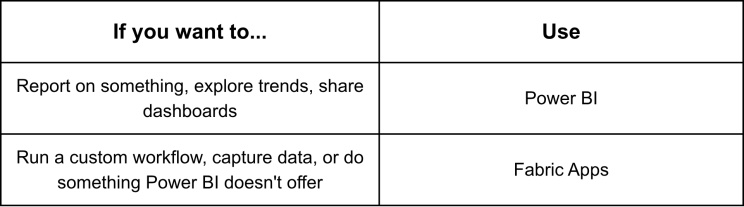
Two practical points make this more than a developer story. First, Microsoft announced it will be available in preview to Power BI Pro and Premium Per User customers, at no additional cost, with a SQL database of up to 1 GB per app. You don’t need a Premium conversation to try it. Second, when an app outgrows its first version, IT can take it over and extend it without rebuilding it. That removes a familiar problem: the business builds something useful on the side, and IT later has to start again.
There’s a catch worth naming. When anyone can build an app in minutes, the hard part is no longer building it. It’s knowing which app is worth building, and what process it should support.
4. Lower barriers to getting started
Several announcements make the first step into Fabric cheaper and less risky.
A zero capacity starting point. Fabric Zero Provisioned (F0), lets you start with Fabric and OneLake without committing to capacity up front. Alongside it, pay for what you use billing is being extended from Spark to every Fabric workload. Together, they mean you can prove value first and decide on capacity size later.
An easier first step off Azure Data Factory. A new upgrade experience lets you bring your existing Data Factory into Fabric and see your pipelines there, using familiar monitoring, before you make any migration decisions. For teams whose migration has stalled because of the unknowns, that’s a practical place to start.
Agents for the heavy lifting. The new data engineering agent, now in preview, takes on complex, long running work such as platform migrations, lakehouse modernisation and complex ETL. Your engineers define the outcome and the guardrails, and the agent plans, executes and checks its own work within them. It also works from tools your engineers already use, including GitHub Copilot, Visual Studio Code and Claude Code.
More of your data, without copying it. OneLake now connects to more sources, including Google BigQuery mirroring (now generally available), a preview integration with Salesforce Data 360, and deeper links into Dynamics 365 Business Central.
5. For your technical team: the SQL news that got less airtime
FabCon shared the stage with SQLCon this year, and some of the database announcements deserve more attention than they got.
SQL Server on Azure Local is generally available, including fully disconnected operation. You get Azure style management while the data stays on infrastructure you control. That’s useful for workloads that need to run on premises, at the edge, or with no cloud connection at all.
Vector search is generally available in Azure SQL and SQL database in Fabric. DiskANN vector indexes now run inside Azure SQL Database Hyperscale, Azure SQL Managed Instance and SQL database in Fabric.Vector search and AI retrieval workloads can run on the same database, security model and T-SQL as your operational data, with no separate vector store to secure and keep in sync.
Azure SQL Hyperscale scales further, and costs less when idle. Hyperscale now scales to 192 vCores, generally available. It can also pause itself when idle, now in preview, which cuts the cost of development and test databases.
What hasn’t changed
The technology is moving faster than ever. The fundamentals are not.
AI is only as good as the data and definitions underneath it. Copilot will only be as trustworthy as your semantic models. Agents will only be as useful as their understanding of how your business actually runs. And when anyone can build an app in minutes, the scarce skill is knowing which one is worth building.
That’s where we’ve spent the last 19 years: understanding business processes deeply enough to know what to build, and making sure the data underneath it can be trusted.
Where to start. If you’re wondering whether your semantic models are ready for Copilot, which agent would make the biggest difference to your team, or which app is worth building first, let’s chat. We’ll help you work out where you are, and what’s worth doing next.
Sources
- FabCon and SQLCon 2026 in Barcelona: Building the data foundation for Microsoft Copilot and agents, Microsoft Azure Blog
- Bringing governed analytics into the flow of work: Fabric Analytics at FabCon Europe 2026, Microsoft Fabric Community
- FabCon/SQLCon Barcelona 2026: What’s new in Fabric Data Factory, Microsoft Fabric Community
- FabCon Europe 2026: OneLake Gets More Data and Stronger Governance for AI, CODE Magazine
This article first appeared in Insight Edge, our newsletter on LinkedIn.