
By Zaahid Allie, Data Analytics Consultant at Insight Consulting.
Part 2 of 3: A framework for what to automate and what to keep
In my last post, I named the problem: cognitive dystrophy, the AI-age habit of automating tasks so early and so completely that the people who would have learned from them never get the chance. Here is the frame I use for deciding what to do about it, because it maps onto every part of the problem, and it comes from a machine most of us trust more than we probably should.
You used to walk to work
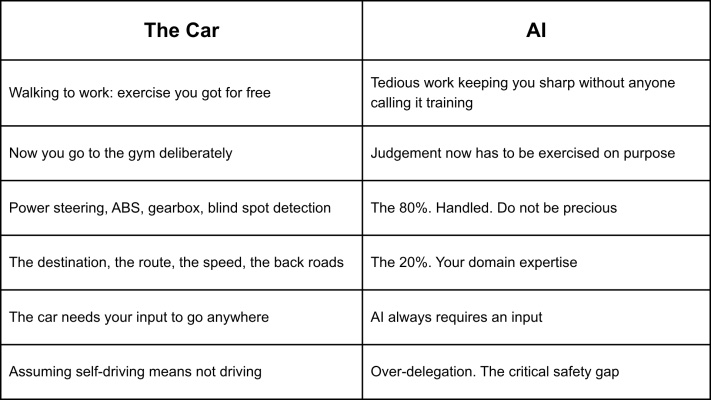
Nobody argues we should give up cars because walking is exercise. But notice what actually happened when we stopped walking. We did not lose exercise we had chosen. We lost exercise we were getting for free.
Nobody ever scheduled the commute as training. And nobody ever scheduled writing the script, aliasing the fields, or reconciling the number by hand as cognitive maintenance either. It kept the underlying capability warm as a side effect of doing the job.
The car did not make us unfit. Assuming the car would keep us fit did.
So the answer is not to walk everywhere again. It is to accept that the incidental exercise has gone, and to replace it deliberately: you run in your area, or you go to the gym. Different activity, same purpose, and now it has to be on the schedule.
Someone always objects at this point: people who drive everywhere are less fit, and most of them never take up the gym. Agree with that enthusiastically, because it is the point. The replacement does not happen by default. A team that says “we’ll be careful” has just said “we’ll get fit eventually.”
The car does not choose the destination
A car gets you from A to B. It does not decide where B is, which route to take, what speed is appropriate, or whether the back roads are worth it today. That is all you, and all of it is domain expertise. The car follows your inputs. AI will always require an input, and the quality of what comes out is bounded by the quality of the direction going in.
The smart features are the 80%
Modern cars handle an enormous amount you no longer think about: power steering, ABS, skid control, automatic gearboxes, blind spot detection, adaptive cruise holding distance to the car in front. Nobody sensible insists on doing these manually to stay sharp. They are handled, handled better than you would handle them yourself, and being precious about them would be absurd.
There is one extension worth making, because it contains the distinction from my last post. There is now a generation of drivers who genuinely cannot drive a manual. In most of the world that is fine, right up until the only car available has three pedals. The driver who could once drive a manual and has gone rusty has atrophy. The driver who never learned, because the automation was always there, has dystrophy. The second one is not careless and not lazy. The capability simply never had a reason to develop.
The driver who stopped paying attention
This is where the metaphor stops being an illustration and becomes the argument.
Self-driving exists, and in production it still requires the driver. In April 2024, the US National Highway Traffic Safety Administration published the results of a near three-year investigation into Tesla’s Autopilot. It examined 956 crashes and identified a “critical safety gap,” linked to at least 467 collisions, 13 of them fatal. The design, it found, led to “foreseeable misuse and avoidable crashes”; the system failed to sufficiently ensure driver attention; and the drivers involved “were not sufficiently engaged in the driving task.”
Sit with what that describes, because it is not a story about a bad system. It is a story about a system good enough that people stopped paying attention. The gap was not between the car and the road. It was between what the driver assumed the system was handling and what it was actually handling.
Eighty and twenty
Roughly 80% of most work is volume, and roughly 20% is substance. The 80% is the most content and the least value. It burns enormous cognitive bandwidth and returns almost nothing.
In code, it is hundreds of lines of boilerplate and syntax. In business intelligence work, it is aliasing fields, renaming across an app, repetitive load-script structure. In writing, it is the filler: an email making two real points running to five paragraphs of framing, softening, and sign-off.
Hand that over, without guilt and without hesitation. Writing boilerplate scripts and aliasing fields is not a skill anyone should be defending. If AI takes it, that is a straight win.
But you choose your own 20%
Cognitive dystrophy requires active engagement to prevent. There is no universal correct split, and I am not going to hand you one; what goes in your 20% is a decision, and different people will draw it in different places for good reasons.
- Reviewing the AI’s output line by line keeps you fluent in the thing itself, and catches overcomplication.
- Solving the problem yourself first, then comparing, keeps the problem-solving muscle and gives you a baseline to judge against.
- Writing the tests that prove the output matches the goal forces you to articulate what “correct” actually means, and that is often the real work.
- Owning the design and direction, delegating all execution, is maximum leverage, and it demands the most rigour about your inputs.
Everyone will land on a different level of what they still want to do by hand, and that is fine. The point of AI is not to replace everything you do unless you want it to. What is not optional is that you make the choice deliberately, rather than discovering in two years which capabilities quietly left.
Two qualifiers that keep this honest
First, the 20% is not always cleanly separable from the 80%. In a hundred lines of boilerplate, one line is a filter condition, an error handler, or a null check that quietly determines whether the whole thing is right. It looks exactly like filler. It is not. So hand over the production of the 80%, and keep ownership of the judgement inside it. You are no longer the person typing it. You are still the person answering for it.
Second, personal choice has an organisational floor. Where you draw your line is yours, for keeping yourself sharp, but some of the 20% is not any individual’s to give away. If a wrong number reaches a client, “I chose to put that in my 80%” is not a defence.
In the final post of this series, I’ll get specific about what all of this looks like in practice, including where my own skills have genuinely slipped, and I’ll close with a practical checklist for applying this on Monday morning.
This is Part 2 of a three-part series on cognitive dystrophy and agentic AI. Part 1 covers the four mechanisms behind skill loss and why “dystrophy” is the more accurate word; Part 3 covers vibe coding, agentic AI, and what to do about all of this on Monday.
Source referenced in this post:
- NHTSA Autopilot investigation findings, April 2024, and recall 23V-838 — regulator investigation, 956 crashes analysed.
This article first appeared in Insight Edge, our newsletter on LinkedIn.