
By Upuli de Abrew, Co-Founder and Director at Insight Consulting.
As organisations look toward 2026, our conversations with customers are shifting away from what technologies to adopt (AI, analytics, cloud, automation), as those decisions have largely been made. The real challenge is more about how to connect these capabilities in a way that delivers sustained business value.
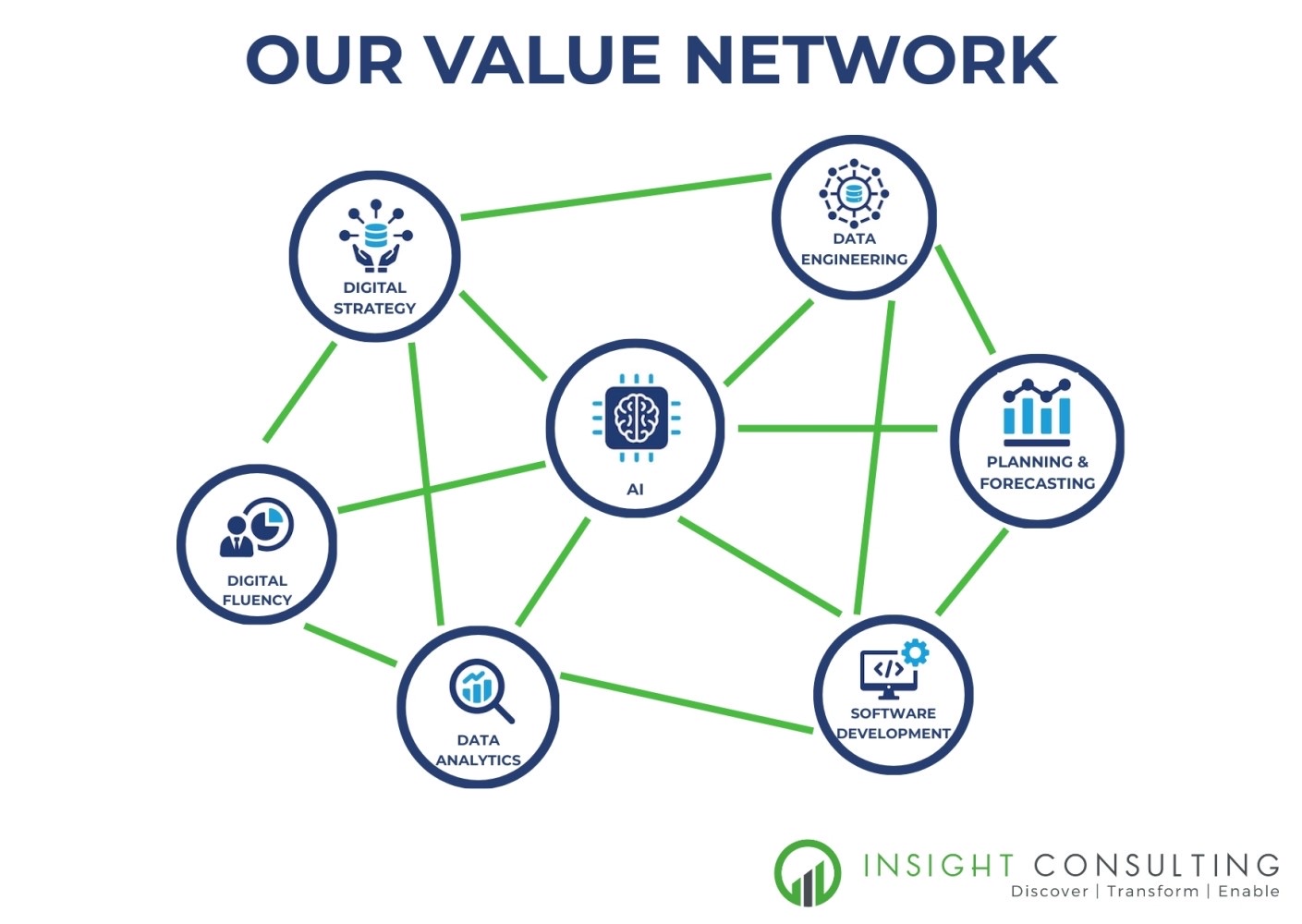
We’re seeing a move away from isolated initiatives toward intentionally designed ecosystems, where strategy, data, technology, people and processes come together to reinforce one another – in other words: a Value Network.
Digital Strategy: From Roadmaps to Direction
Digital strategy in 2026 is accelerating away from being a static, IT-led exercise to becoming a core leadership discipline. High-performing organisations are moving beyond technology shopping lists and focusing instead on:
- Clear business outcomes
- Prioritised digital investments
- Measurable value delivery
A modern digital strategy answers hard questions:
- Where should we differentiate digitally – and where shouldn’t we?
- Which capabilities matter most to our customers and operations?
- How do data, AI, analytics, and software work together to support this?
Most importantly, digital strategy provides sequencing. It ensures organisations understand the importance of putting in the foundations of data, skills and governance first, before deploying advanced capabilities.
In 2026, digital strategy is about creating coherence in a constantly changing environment.
AI: From Tools to Teammates
2025 was defined by AI experimentation; in 2026, organisations are looking towards intentional execution. Our customers are moving beyond generic use cases and starting to design AI around how work actually gets done. This typically takes two complementary forms:
- AI assistants, which help individuals work faster, focus better, and make more informed decisions.
- AI agents, which automate and orchestrate multi-step processes across systems.
Assistants enhance human capability, whilst Agents streamline end-to-end workflows. Together, they allow organisations to scale impact without scaling complexity.
Critically, successful AI strategies remain flexible. Organisations start with ready-made capabilities, extend them using their own data and rules, and selectively invest in custom AI where differentiation matters most.
As AI becomes more embedded in organisations, governance and trust are critical considerations. Businesses need to focus on responsible AI – with clear accountability, data protection, and human oversight – as a prerequisite for adoption at scale.
In 2026, AI moves away from being a standalone initiative to becoming a force multiplier for every other capability in the business.
Data Engineering: The Infrastructure Behind Every Capability
Behind every successful AI or analytics initiative sits the critical, foundational capability of data engineering. Our customers are increasingly recognising data platforms as core business infrastructure, rather than back-office plumbing.
Modern data engineering enables:
- Reliable, scalable access to data
- Integration across operational and analytical systems
- Support for real-time and advanced use cases
- Strong governance without sacrificing agility
Without this foundation, AI models lack context, analytics lose credibility, and decision-makers lose trust. Leading organisations treat data engineering as an ongoing product, not a one-off project – continuously improving pipelines, quality, and performance as business needs evolve.
Data Analytics: From Reporting to Decision Enablement
While dashboards remain useful for KPI tracking, and analytics remains key for detailed analysis, the real shift in 2026 is toward analytics that actively supports decisions, not just reports on the past.
This includes:
- Embedded analytics within operational systems
- Context-aware insights surfaced at the moment of action
- Predictive and diagnostic analytics, not just descriptive views
When analytics is integrated into everyday workflows, adoption increases dramatically because insight arrives where decisions are actually made.
The role of analytics teams is also evolving, and with that comes the need for upgrading some skills. Rather than producing static reports, teams will focus more on:
- Defining meaningful measures
- Framing the right questions
- Communicating understandable and actional insights effectively through data storytelling
Like data engineering, In 2026, analytics projects shouldn’t be seen as destinations, but rather as capabilities that move with the business.
Planning & Forecasting: Turning Insight into Foresight
As analytics matures, our customers are recognising that insight alone is not enough. The next step is turning insight into actionable foresight.
Modern planning in 2026 moves beyond static budgets and quarterly forecasts. Organisations are embracing:
- Continuous planning cycles
- Driver-based models aligned to operational reality
- Scenario planning that reflects uncertainty and volatility
- Forecasts informed by real-time data and analytics
Planning and forecasting acts as the bridge between analytics and execution. It enables organisations to test assumptions, understand trade-offs and align decisions across finance, operations and strategy.
When integrated with AI and analytics, planning becomes more adaptive, supporting faster responses to market changes and internal shifts.
In 2026 planning moves from a periodic finance exercise to a dynamic decision-support capability embedded across the organisation.
Digital Fluency: The Human Multiplier
Technology does not create value on its own. For true ROI on technology investments, businesses need to ensure that their employees are using the powerful tools at their fingertips effectively and wisely.
As digital capabilities become ever more powerful, the gap between organisations that invest in digital fluency and those that don’t is becoming increasingly visible.
Digitally fluent organisations ensure that:
- Employees understand data, not just red or green indicators on dashboards
- Leaders know how to question AI-driven insights
- Teams trust and act on what they see
Digital fluency is not about turning everyone into a data scientist, but rather about building confidence, curiosity, and critical thinking across the organisation.
In 2026, this human capability is the critical component in ensuring that technology actually delivers results.
Software Development: Turning Strategy into Reality
As strategies become more digital, software becomes the execution layer. Off-the-shelf platforms remain important, but differentiation increasingly comes from:
- Custom applications supporting unique business cases
- Integrated digital workflows
- Software that embeds analytics and AI directly into operations
Modern software development in 2026 emphasises:
- Composable architectures
- Rapid iteration thanks to AI
- Strong integration with data and AI platforms
The organisations that move fastest are those that treat software as a strategic capability.
Why the Value Network Matters
Each of these capabilities is powerful on its own, but none of them can deliver sustained value in isolation:
AI without data breaks.
Analytics without fluency stalls.
Software without strategy drifts.
The organisations that succeed in 2026 are those that intentionally design a Value Network, where:
- Digital Strategy sets direction
- AI amplifies intelligence
- Data Engineering provides trusted foundations
- Data Analytics enables decisions
- Digital Fluency drives adoption
- Software Development delivers execution
At Insight Consulting, we help organisations build and activate this network – turning digital ambitions into measurable business impact.
This article first appeared in Insight Edge, our newsletter on LinkedIn.